Thursday, March 5, 2026

Kane-Materialistic


3/5/26

Revised Idea: 

I would like create a room similar to a blanket fort, filled in an overwhelming fashion with stuffed animals and pillows. This is a space in which one would have to crawl into, with blankets creating a low ceiling. Muffled sounds of intensive arguing and aggressive footsteps will be incorporated, which will then be followed by deafening silence. This period of silence will be long enough for viewers to feel like the fighting might be over, only for it to start again. Experiences like this were common in my childhood and are also very prominent in today's political climate. 

Many people have used escapism as a tool to cope with real life situations, which can be healing at the same time that it can also be detrimental. This installation aims to provide a space that feels like the viewer is within range of the fighting and danger, but hidden away somewhere safe for the time being. The overwhelming amount of soft objects will contribute to the need for comfort, with the sheer number becoming a visual metaphor as to how badly this escape is needed. The experience aims to provide a sense of escape from the fighting hatred while also being aware of the impossibility of a true form of avoidance in regards to the problems we as a society face, both personally and politically.


 Materials List:

  • Stuffed animals, estimated 100-200
  • Cushions and pillows, estimated 10-20
  • Blankets and comforters, estimated 10-20
  • Speakers, 1-2
  • Devices to stream music to speakers, 1-2
  • Safety pins, tacks, nails, 100-200 


 2/19/26

 Idea: Teddy Bear Sanctuary

In today's world, I feel it is crucial to have safe spaces for people to retreat to when the current social climate becomes too much. Rest and recharging are important to the human psyche. Many adults also have lost their whimsy and wonder in their journeys from childhood to adulthood, and I would like to help bring those feelings back. In my installation, I aim to create a space reminiscent of blanket forts and playrooms but made to accommodate adults. This space will invite viewers to reclaim their childhood whimsy and enter a soft, warm, and safe place away from their current struggles of adult life.


 Materials List:

  • Blankets (preferably soft and/or patterned)
  • Low table or pedastal
  • Stuffed animals (like a billion)
  • Cusions/Pillows
  • Ball pit
  • Ball pit balls 
  • Tea Set + Snacks
  • Nails or tacks or something idk


Artist Inspiration:

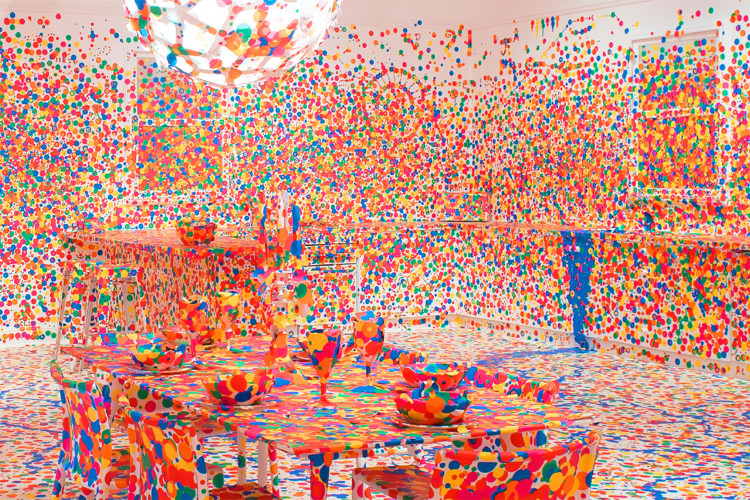
I am once again inspired by the artist Yayoi Kusama, specifically her Obliteration Room installation. Like my Mini Installation, I am inspired by Kusama's usage of color, multiples, and transformative nature of space. Kusama's approach to installation will be incorporated into my work through the implementation of bright, rainbow colors, repetition of blankets and stuffed animals, and the complete transformation of the room into a large blanket fort suitable for the viewing experience.

Yayoi Kusama | Dunedin Public Art Gallery


The impulse toward refuge, softness, and reclaiming whimsy is generous. But right now this reads like a themed room, not an installation.


What’s Strong

  • The concept of sanctuary.

  • The acknowledgment of burnout and overstimulation.

  • The desire to create a physical retreat.

  • The interest in the transformation of space (good instinct referencing Yayoi Kusama).

You understand that installation can change an entire room. That’s promising.


Where It’s Weak (Right Now)

  1. It reads like a college dorm hangout.

  2. “Stuffed animals (like a billion)” signals lack of precision.

  3. A ball pit + tea set + snacks risks novelty over meaning.

  4. The concept is very general — “the world is hard” — which flattens the emotional depth.

You need to edit.


What You Needs to Clarify

  • Is this about childhood memory?

  • Is this about escapism?

  • Is this about regression?

  • Is this about the loss of innocence?

  • Or is this about overstimulation and sensory reset?

Right now, it’s vague comfort.

Installation needs tension.

Even sanctuary needs stakes.


Kusama Reference 

Kusama’s Obliteration Room worked because:

  • It began white.

  • It transformed over time.

  • Participation mattered.

  • Repetition had conceptual grounding.

If you reference Kusama, you need:

  • A transformation.

  • A system.

  • A rule.

Not just “a lot of stuff.”


The Ball Pit Question

Ball pit = high risk.

It becomes:

  • Instagram.

  • Novelty.

  • Liability.

  • Cleanup nightmare.

Unless it has conceptual grounding, I would advise removing it.


The Stuffed Animal Issue

Quantity is not concept.

Instead of “a billion stuffed animals,” what if:

  • They are all missing an eye.

  • They are all monochromatic.

  • They are stitched together.

  • They are suspended instead of placed.

  • They form a wall.

Repetition needs structure.


How to Push This Toward Installation

Instead of:
Blankets + pillows + ball pit + tea set.

Consider:

  • The entire ceiling lowered by hanging blankets.

  • A compressed space you must crawl into.

  • Sound dampened.

  • Light softened.

  • Outside noise faintly audible.

Now it becomes psychological architecture.


I appreciate your desire to create a sanctuary. That impulse is generous and needed. However, right now, this reads more like a themed room than an installation. Installation requires a clear system or transformation.

If you’re referencing Kusama, ask yourself: what is the rule? What changes? What is repeated with intention?

Be careful of novelty elements like a ball pit or tea set unless they serve the concept directly.

I want you to define what kind of sanctuary this is. Is it refuge? Is it regression? Is it escapism? Is it critique? That clarity will determine the materials you keep and the ones you remove.

Wednesday, February 25, 2026

Sam R - Materialistic

Filled Space - Wrapping up

Images


Process

The process of making this began very slowly. I drew out some sketches to ideate what my piece should look like, drawing the rooms and faces, figuring out where the cords should go on the faces and where the faces should go. Then I had to think about the materials that I could really use within this process and what would best represent the ideas that I’m trying to convey. I knew I wanted wire and electronic found items as a base, and I thought of the humanity aspect, so a human face felt like a great way of depicting humanity. Instantly, we’re putting two unlike things together in the same room, which causes viewers to immediately compare and contrast the two.

After figuring out materials, I had help obtaining wires, and then I started thinking about how I would make a face. I first thought of chicken wire to mold to my face and gauze to harden over it, but I realized the chicken wire wouldn’t be a great mold. The best option was to find already-made faces, either sculpted ones or other students’ wax molds, and layer them with gauze. After that, I was able to decorate them and make them look steel-like for the robotic look, using silver spray paint and some black acrylic dry brushing.

I fitted them with wires, which at first I would just slap on and call it a day, but then I realized I needed it to be more organized for my own personal aesthetic and for the piece itself. Thinking about the impact computers have had as something that operates to organize the human world, I wanted to reflect that. Computers have always been about organization, so I wanted to show that through the structured nature of the wires protruding from the mask. I also noticed that I needed something to hang it up with, and that through the eyes you could see the hanging device. I thought that could be solved by adding a cloth mesh around the eyes so the viewer would have a harder time seeing how it was hung.

Next, I had to fit them to the wall. This part was extremely challenging for me. I began by setting a nail where I wanted the mask to sit, then pinning each individual wire to the wall where I wanted it, making it seem like it was blending into and taking over the wall itself. That part was fine, and so was adding wires to the neck to connect it to a nearby device. However, stepping back, it looked so barren, and I felt really disappointed. Especially with how much work I had put in, it felt like there wasn’t much to show. I had to switch gears and really dig into what it means to make an installation. After talking with a few peers and Swoon, they helped me realize I was working too small and that I needed to use my entire body for the installation. I was so focused on what my hands could do that I didn’t realize I had an entire body and space to work with. It seems so obvious now, but I’m grateful to have gotten the advice when I did.

Finally able to switch gears, I began throwing things into the space and caring less about perfection, focusing more on experimentation and wabi-sabi, letting the piece develop itself as I placed things down without overthinking. This ended up working out really well. As I filled the space with random wires, I thought about incorporating the long extension cords Ashley gave me, which helped fill the space so much. I was also generously given a breaker box from Brock, which took up space nicely and fit cleanly within the aesthetic.

I really enjoyed the process of placing cords and other items down and seeing how they would interact. I would wrap wires around other wires in a very organized manner, put some into the breaker box on one side and out the other to make it look like there was something hidden going on inside. I hid items throughout like Easter eggs (pressure gauge, Apple mouse). Overall, after getting over that big hurdle of perfection, I was able to really let loose and enjoy the process. With all the materials gathered and made, it was time to place things down, step back, and move them around. This was definitely my favorite part of the installation.

Finally, I figured out the lighting and the projector as a finishing touch, covering the lights with blue gels and pointing them to emphasize certain parts of the installation. I experimented with whether the projector should sit above or below, and it had to be placed below. I found a device (an old Chromebook), hooked it up, aligned the projector to fill areas where the piece felt lacking, and found a video to project. Considering what this piece was about, I wanted something raw that matched the aesthetic, so I chose old computer source code. I found a short video on YouTube showing a constant feed of source code running in a command prompt, which felt more authentic and less corny than the green hacker numbers video I had found before. It helped present a more computer-like vibe to the installation, which ultimately made it feel more complete.

Reflection

Statement

My installation centers around the relationship between technology and humanity. The work invites the audience to ask questions about where technology belongs in our society and what place it holds in our world. Technology has fascinated me since childhood and continues to do so. It has brought me to amazing, interesting places, but it has also led me into darker ones.

The internet is treated as its own entity, and my work personifies that idea, encouraging viewers to consider how it should be understood and respected. It is an incredible tool, but it is also a double-edged sword that can easily lead to harm. The wires and scavenged PCBs evoke an element of technology, while the faces represent humanity. Placing these unlike elements side by side encourages comparison and contrast between the two.

Ultimately, the installation asks viewers to reflect on their own relationship with technology, not as something separate from themselves, but as a force that is deeply embedded in and reflective of human behavior.

 Filled Space - Continued

I've been able to rework/figure out my vision a little more clearly. I now understand that masks and wires are an essential part of what makes up my installation. Another important factor is because its digital vs organic it makes sense to make digital things more organized and organic things more organic. wires coming from digital objects will be straight and organized wires passing through and out of organic components will be more vein-like and branched, attaching to the wall. 
    the first idea I have drawn out felt a bit messy so I re worked it in the second page and makes more sense thematically, more info on pages below


My biggest concern right now is figuring out how to make the masks, what to make them out of and what color to make them. My initial thoughts led me to chicken wire and gauze to then be able to color it in some way? some other thoughts may be paper casting from masks and faces of students that have already been made?


Filled Space - Installation ideation / materialistic 

Following the theme inspired by Nam Jun Paik's work "TV Garden," I wanted to continue making things that speak about technology vs humanity/technology vs environment. 


There are only two movable walls. 


This time I want to explore more with the technology aspect and play with a matrix panel. it could debatably take up more time than I have to experiment with something like that which in that case it can be replaced with some other entrancing piece of technology to set in the middle of the piece. I think the main mood I want to convey is whatever the faces are attached to is something that is inherently "entrancing". to inhibit this more entrancing affect I want to incorporate the use of line to radiate emphasis. 


Materials:

Sculpey
Maroon-colored tissue paper
Maroon/ blue yarn
22 gauge electrical wire
RGB LED Matrix Panel


Big Picture

You’re onto something with:

  • Technology vs humanity

  • Entrancement

  • Radiating line

  • Wires as connective tissue

But currently this reads as a central sculptural object with decorative extensions, not an installation that consumes space.

If you’re inspired by Nam June Paik and his work TV Garden, remember: the power wasn’t in a single object — it was in the environment. The TVs were embedded in a field. The space itself became the content.

You need to shift from:

“What am I building?”

to:

“What is happening to the room?”


1. Move From Sculpture to Spatial System

There are only two movable walls. That constraint should drive the design.

Right now:

  • Sculpey heads = sculptural

  • Yarn = decorative surface

  • Matrix panel = central object

Instead, ask:

  • What if the wires dominate?

  • What if the walls become the field?

  • What if the faces are absorbed into the system rather than sitting on it?

Installation is about relationship, not object.


2. The Wire Is the Strongest Material

The 22-gauge electrical wire is conceptually perfect:

  • It references circuitry

  • It references nervous systems

  • It can radiate, connect, invade

Push that.

Instead of yarn radiating emphasis, what if:

  • Wires stretch from wall to wall?

  • Wires converge at the panel?

  • Wires attach to faces like neural connections?

The line becomes literal and conceptual.

If the mood is “entrancement,” then the wires should feel like:

  • Pulling

  • Plugging in

  • Feeding

  • Draining

Make the wires the protagonist.


3. Move Away From the African Mask Reference

What you have currently drawn risks:

  • Cultural appropriation

  • Formal borrowing without context

  • Distracting from the concept

Options:

  • Photographs of real faces (taken by you)

  • Screenshots of scrolling faces from social media

  • Large-scale printed faces adhered directly to wall

  • Faces drawn/painted directly onto the wall surface

  • Chicken wire facial structures that feel incomplete or hollow

The wall can hold the faces.
The space holds the wires.
The wires connect to the technology.

That becomes installation.


4. The Matrix Panel Question

The RGB LED matrix panel could be powerful — but only if it:

  • Emits flickering light

  • Displays scrolling code

  • Pulses rhythmically

  • Mimics algorithmic patterns

If it just “sits there,” it becomes a gadget.

If time is limited, consider something simpler but effective:

  • A looping glitch video on a small monitor

  • A phone mounted and endlessly scrolling

  • A light source that pulses like a heartbeat

Entrancement is about repetition and glow.


5. Rethinking “Filled Space”

Right now your materials feel surface-oriented (tissue paper, yarn).

Instead ask:

  • Does the viewer walk through wires?

  • Do the wires cross the room?

  • Do they cast shadows?

  • Does the light from the panel project wire shadows onto the wall?

Filled space means:

  • Air is activated.

  • Negative space matters.

  • Movement through space matters.


6. Material Notes

Sculpey

Feels heavy and craft-based unless treated very intentionally. Might flatten the conceptual strength.

Tissue paper

Could look decorative unless distressed or treated conceptually.

Yarn

Unless it’s functioning as line in space, it reads soft and textile — which may contradict the tech tension.

Wire

Keep.
Push.
Multiply.


Right now this is leaning sculptural — individual heads attached to something central. I want you to push it further into installation. Think about the room as your material. The wires feel the most conceptually strong. What happens if they dominate? What happens if they stretch from wall to wall and the faces are absorbed into that system rather than sitting on top of it?

Also, I would move away from the African mask reference. It complicates the work unnecessarily. Consider using faces you photograph yourself, or printed faces transferred directly onto the wall. That keeps the focus on technology and entrancement rather than cultural form borrowing.

The matrix panel only works if it actively produces glow and repetition. Otherwise it’s just an object. Ask yourself: what is the viewer physically experiencing in this room?


Where This Could Go (If Fully Pushed)

Imagine:

  • Two walls with large-scale printed faces

  • Hundreds of thin wires radiating from a glowing matrix panel

  • Wires attaching to faces’ eyes or mouths

  • Viewer walking between wire lines

  • Light flickering

  • Shadows multiplying the wires across the wall

Now the room becomes the nervous system.

That’s installation.


Delaney- Materialistic

Reflection After Critique - 3/26/26

    One thing that I really wish was different about this installation (and a sentiment that was definitely echoed in critique so now I know I'm not crazy) was the lack of hair outside of the cocoon. As is reflected in my concept art prior to beginning this piece, I initially wanted to have hair hanging from the ceiling, descending down to the floor, and sticking to the walls. Unfortunately, I severely underestimated just how much hair it would take just to cover the cocoon. I kept having to order more, and I didn't have any left by the time I covered the cord attaching the piece to the ceiling with hair. In the future, this is definitely something I would want to built upon, adding way more hair all over to make it more overwhelming.

    It was also recommended that I add more bathroom/toiletry items to the room, and maybe more of a shower curtain to the door. I do really like the idea of a frosted shower curtain over the door- I tried to do this, but the shower curtain I bought was pretty small so it doesn't quite look like I intended. I think a longer one, attached to some sort of bar like shower curtains are, would be good. I'm not sure how I feel about adding more bathroom supplies though. I did consider this while I was installing, but ultimately didn't because I was worried about doing too much and taking away from the piece. I want every object I use to have a reason and a meaning, and I'm just not sure if I can justify other bathroom items as anything other than setting a location.

    I would like to add smell to this installation in the future. I just don't fully know what smell would be appropriate or how to go about adding one. I considered hairspray, but I kind of hate that smell. I also worry about further deterring anyone from viewing my work based on that.

    Another thing I would do different next time is adding more tile. I actually originally planned on covering the entire floor in tile, but that's more expensive than I thought. I ended up finding some stick-on wallpaper that looked kind of like tile, so I bought that. Unfortunately, I got my math extremely wrong and didn't have anywhere near enough to cover the floor. That's when I pivoted and cut up the tiles to only place directly under the cocoon, hoping it would look intentional. I think this worked out pretty good, but I'd definitely want to cover the floor next time.

    I also wish I would've made the body of the woman longer. I originally also wanted to have a knee sticking out of the cocoon, but I was running out of time and unsure how I wanted to construct this, so I didn't. I would love to revise it and add that knee in the future.

    Overall, I'm pretty content with what I made. I know I could do better, but I think I still made something pretty cool, and I'm happy with that.


3/23/26

I added finishing touches as far as I could to my installation. I also wrote my artist statement and came up with names for the piece, as well as looking at audios to add sound to the room.

That is about all I did before spring break!


3/10/26

This week, I finished making my installation and installed it in the "That" gallery. I wish I would have taken more pictures of my project, but I got a little too into it and forgot unfortunately.


    The bulk of the work I did was sewing in strips of hair into my piece as I thought. I also had to order some additional hair because covering my structure took a lot more than I expected. My helper had the idea of needle-felting into the foam-base of my piece to cover more ground, which helped a lot. I do not think I would've ever been able to cover the entire surface in hair if not for this.


    The part of the process I enjoyed most about this project was painting the face and the hand. I always enjoy painting things the most in any project, so doing this was like a little treat. I really didn't enjoy sewing strips of hair to the hammock though- that part of the process almost made me lose my mind. If I could do this piece again, I may consider a different method for attaching hair.

3/2/26

    So far, I am comfortable with the amount of progress I'm making. I've been able to follow my planner for the week and meet the milestones I made for myself on-time, which I'm happy for!

    Over the weekend, I began sculpting the face for my piece. I received suggestions in class not to try and sculpt a face from scratch considering the time constraint, which I agree with. However, I didn't really want to use the face-casting idea for this piece, because I don't really want the girl depicted to look like me- or anyone else, really. As an alternative, I decided to sculpt a face over top of a mask I found, which saved me a lot of time while still allowing me to make a face.


     I am not finished painting her yet- I got kind of tired and plan to finish her tomorrow. However, I am going for a painterly-vibe for her face and hand (I found a plastic hand which I am very excited about!). I'm not entirely happy with how her face came out- I think I may be happier when I finish painting and refining her. I also keep reminding myself that portions of her face will have strands of hair over them, so I have a bit of wiggle-room here.


After that, I decided to begin experimenting with making hair out of yarn. I planned on doing this from the beginning- but I would like to note that I found a really long wig, which means I'll probably be able to cover more ground than I thought with wig hair and the hair extensions that were ordered for me. I do still think I will need to use yarn-hair to cover more ground though. My plan is to use yarn on the bottom-layer of the cocoon and use my nice-hair overtop.

Anyway, I think I've figured out how to make yarn look somewhat hair-like! Here is my first weft of hair with yarn:


    I've decided this will be the most time-consuming part of my project, so I plan on focusing most of the week on finishing the body-parts for my lady and making hair! I'm attaching a piece of yarn to the top of each weft I make so that I can tie it to the hammock that was ordered for me- it's a rope-hammock, so I think this will make the assembly process much easier. 

I'm definitely feeling a bit more confident about my installation now that I have my process and materials figured out.

I also bought a shower drain cover this weekend for my piece!

Answering questions from Last Week:

I am focusing more on an idea of Isolation/Containment. I've seen hair used as a metaphor for memory before, which is an idea I think is interesting. There's sort of a belief some people hold of hair holding memories, which I like. More than that, I think hair is difficult to get rid of- we find stray hairs all around, maybe in our beds, in the cracks of a couch cushion, the holes of a shower drain, etc. Hair is perpetually present in our lives. If we go by the logic of hair holding memories, its like no matter what, these things will linger somehow. That can feel suffocating and confining, in a way. This piece is supposed to approach the idea that life experiences mold us, and that everyone we meet will affect our lives in some way, and view this idea through a lens of contamination and something binding.

The drain in this piece is meant to remind us of a shower- a place where we clean ourselves. However, for me, when I see a hairy shower drain, I feel reminded that being a person is dirty- having a body and existing is inherently gross, which is usually easy to overlook because we inhabit our bodies- but there's so much about the human body that is gross, and then I feel like not even a shower is truly a clean place. This thought process, to me, makes the hairy drain a good indicator that the feeling of being contaminated is not a feeling that you can just wash away- it's not a physical dirty-ness, after all.

To be clear, though the visual of this piece and the concept was inspired by an experience I had, I don't necessarily intend for the piece to be about me specifically, or even about that specific thing that happened. I draw inspiration from things that have happened to me because I don't feel like I can do a good job conveying a feeling I haven't felt or a type of experience I haven't had. But in the end, I've decided that the meaning of this piece is a bit more vague. It depicts a girl, plagued by memories held in the hair she's cocooned in.

For the installation, I want the cocoon to be in the corner of the room, with the shower drain somewhat in front of it. I want her to hang up sort-of high, but not so high to where she feels inaccessible to the viewer. I want some hair to hang down from the ceiling too. I also  want to make the lights red to create a feeling of unease and discomfort in the space. I am also somewhat interested in including sound in my installation if possible- I think a subtle dripping-faucet sound might be neat and contextualize the shower-drain a bit more. Dripping faucets to me, indicate that a sink/shower may not be well-maintained or looked-after, which makes me feel a bit uneasy about using them.


2/24/26

    After bouncing my ideas off of other people, I've decided to go with my second idea with the hair-cocoon, as I think it is more feasible and maybe a bit more visually interesting. I will be refining it a bit and drawing up a few more concept sketches so I'm sure what my plan is before I get too far into my process.
 
Here's my materials list:
  • Black Yarn
  • Hair Extension
  • cardboard
  • air-dry clay (I have)
  • Paracord or something for hanging?
  • white fabric for ceiling and floor.
  • something I can put over the lights to make them red? I'm not sure what I can use for this.

2/19/2026

    I'm still a little bit undecided on what idea I want to go with, but I have two solid concepts that I'm happy with and excited about.


Idea Development


Idea #1

    My first idea was for my installation to be depicting a wake. I think wakes are an interesting thing- I think sitting there with the body of a loved one, really spending time with their body, is kind of a unique experience. I can't speak for everyone but I think spending time with the body really helps the grieving process, as you are confronted with the reality of the situation and must let the fact that they're gone sink in. For me, when I haven't gotten to spend time with the  body, I find myself struggling to come to terms with what happened in my mind. Like, logically, I know that person is dead- but because I haven't seen it, I feel like I almost forget that they're really gone, or have trouble wrapping my head around it. Whereas, when I have spent time with the body, I feel like my grieving process is more grounded in reality. It still sucks and is sad, but for me, it is a bit of an easier mourning process.

    Anyway, My idea for this piece is to have a sculpted-body laying in a bed. Their face is veiled, but you can still see the contours of the human face- vague nose shape, etc. My intention with this is to strip the individual of any set-identity so it can be interpreted as anyone. Then, by the bedside, I would have a small table and chair where a viewer can sit and spend time with the work. On the table, there would be an open notebook where the viewer is invited to, if they choose, write about their experiences with grieving or about a loved one. There would also be a vase with flowers where the viewer is allowed to take one and lay it over the body to sort of pay respects.

Idea #2

    My second idea is based  on a feeling from an experience I had a few years back. I'll be vague, but for context, I used to date somebody who was not very mentally stable and I had a lot of scary experiences with him as a result. For some reason, even though this was by no means the worst thing to happen, what stuck with me was this time when he was on top of me- I'm not very strong, but my fight or flight kicked in, and I bit his hair, pulling it out. This really haunted me- I felt guilty even though really, I know what happened wasn't without reason. But I found myself constantly feeling like I had hair in my mouth, even when I didn't. I don't think I'll ever forget the feeling of hair between my teeth. I was left with this lingering feeling of being gross or dirty.

    So, that's what this piece would be about. I depicted a girl wrapped in a cocoon of hair, with a shower drain beneath her that has hair coming out of it. I obviously can't find that much hair, so my idea  was to sculpt and paint some of it, but use brushed-out yarn for a large portion to get the effect of hair. Then, for smaller strands I would use some wig hair- I actually have a pretty long black wig that I'm not really attached to, so maybe I'd use that. I would like to sculpt some of the girl's body parts- mainly her face, an arm, and a bit of a knee, but I will be obscuring a lot of this with hair, so I'll probably only sculpt some parts to make it lightweight. I thought I would mostly use some foam, paper mache, and maybe some air-dry clay for certain features, all sealed with a few layers of mod podge to keep it together. To suspend this from the ceiling, I figured it would probably be most structurally sound to use some sort of cord that I can easily hide with the "hair". I'll try to make this pretty light-weight, but I will still have to be careful that it's structurally sound so it doesn't fall.


    I'm not set on either of these ideas yet. I really like both, so any input on which one I should go with and develop further would be appreciated!


Conceptual Strengths

1. The sensory trigger is powerful.
The “hair between the teeth” memory is visceral. It’s not just narrative — it’s embodied memory. That’s strong installation territory.

2. Hair as material = metaphorically loaded.
Hair carries associations of:

  • Intimacy

  • Bodily residue

  • Disgust

  • Gender

  • Power and entanglement

You are working with a material that already holds meaning, which is good.

3. The cocoon form is promising.
A cocoon suggests:

  • Protection

  • Containment

  • Metamorphosis

  • Isolation

But right now you needs to clarify which of these ideas you activating.

Where You Need to Push Further (Conceptually)

Right now, the piece risks being illustrative instead of immersive.

  • Is the girl trapped? Or self-wrapped?

  • Is this about guilt? Or violation? Or contamination?

  • Is the drain symbolic of release, or accumulation?

  • Is the cocoon protective or suffocating?

If you dont define this, the work will read as “trauma sculpture” rather than a focused installation.

You have the core — now you need precision.


Installation Questions to Push You

Since this is installation, not just sculpture:

  1. Scale

    • Is this life-size? Smaller? Suspended at eye level?

    • Does the viewer walk under it? Around it?

  2. Viewer Relationship

    • Can the viewer see the face clearly? Is it female? Is it you?

    • Is the hair dense enough to obscure and frustrate visibility?

  3. Space Activation

    • Is the drain on the floor?

    • Is the hair touching the floor?

    • Is this in a corner? Center of the room? Overhead?

Right now, you are describing an object. You need to describe an environment.


Material & Structural Feedback 

 Material choices could cheapen the emotional weight if not handled intentionally.

1. Foam + Paper Mâché + Air-Dry Clay

This combo is workable, but:

  • Air-dry clay cracks easily.

  • Mod Podge is not structural.

  • Paper mâché can sag over time.

If you are suspending this:

  • You need an internal armature. ( I bought you a hammock so that should help)

  • Lightweight = good, but structural integrity matters.

Suggestions

  • Chicken wire to help form body shape

  • Plaster cloth over structure 

  • Clear fishing line or aircraft cable instead of visible cord


2. Yarn as Hair

Brushed-out yarn can work — but it can also look crafty.

I encourage you to test:

  • Different yarn types (acrylic vs wool)

  • Density layering

  • Matte vs synthetic sheen

  • Incorporating real wig hair for realism

The difference between “haunting” and “Halloween” will be density and restraint.


3. The Drain Element

The drain is strong symbolically — but it could easily become too literal.

Questions to refine:

  • Is hair emerging from the drain?

  • Is it being pulled into the drain?

  • Is it a cycle?

You could consider:

  • Real metal drain fixture

  • Hair trailing down into the drain

  • Or drain mounted vertically instead of on floor to disrupt expectations


Emotional Arc

Right now, the work is stuck in “gross / dirty.”

 Consider:

Is there transformation?

If it’s a cocoon, what happens next?

Even if the answer is “nothing,” you need to consciously choose that.


Safety + Sensitivity Consideration

Given the content (physical threat, bodily memory), I suggest:

  • Do you want a short wall text?

  • Do you want to contextualize it?

  • Are you emotionally ready to display this publicly?

Not to censor — but to protect you.

Bri - Site Specific

5/5/26 - Executive Summary and Finished Installation Budget  Materials: Southside Elementary School Proposal                        Brianna ...